Palaeontologists who attend the annual International Cave Bear Symposium (ICBS) can usually count on at least one expedition to a bear cave. The meeting allows scientists to report the latest fossil findings of Pleistocene animals such as cave bears and big cats — whose best-preserved samples are often found in caves.
But the 2015 meeting on 10–13 September took place instead near the North Sea coast in the Netherlands, with no caves in sight. Palaeontologist Natasja den Ouden of the Naturalis Biodiversity Center, a museum in Leiden, tells Nature how fossil samples from the North Sea are shedding light on mammals’ movements during the last ice age. Continue reading Fishing for fossils in the North Sea→
On its way from flight to fossil, an ancient beetle’s wings lost their color and then their form. Slow-baked and squished by sand, the glittering green wings darkened and turned blue, then indigo, then black.
That tale of an insect’s life, death and fossilization sounds simple enough, but it took paleobiologist Maria McNamara years of painstaking work to piece together. The University of Bristol researcher wanted to know how ancient insects’ warning signals, camouflage and mating displays evolved. Studying ordinary fossils tells only part of the story, since most fossilized insects are black today, probably because they lost their colors while buried underground. Continue reading Faux Fossils→
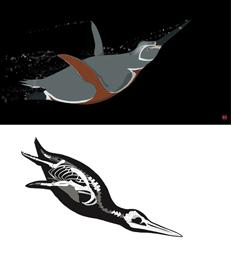
A 36-million-year-old fossilized penguin skeleton found on a cliff-face in Peru has given scientists insight into how penguin feathers, originally used for flight, adapted to swimming. The fossil, found by palaeontology student Ali Altamirano of the Museum of Natural History in Lima, contained intact pigments which researchers say mean that, instead of the black and white plumage of modern-day penguins, the ancient bird sported grey and reddish-brown feathers.
Read the rest of this news story on Nature News [html] or here [pdf].
A new defence of the fossil Ida as a precursor to today’s primates, including humans, has emerged from the research team that last year bought and promoted the 47-million-year-old remains.
Ida, or Darwinius masillae, was described in 2009 by Jens Franzen at the Research Institute and Natural History Museum of Senckenberg in Frankfurt, Germany, and colleagues, who identified it as a haplorrhine, precursors to modern-day monkeys and apes. However, two studies by other groups since then citing evidence from a new fossil and an independent study of similar primate fossils concluded Ida was closer to the strepsirrhine branch, precursors to today’s lemurs, (see ‘Fossil primate challenges Ida’s place’). Continue reading Palaeontologists go to bat for Ida→
Technology policy editor at IEEE Spectrum Magazine