In February 1996, U.S. President Bill Clinton signed the Telecommunications Act, which boosted competition and loosened broadcasting requirements. It also set a baseline of telecom service everyone should have and set up funding to pay for it.
Thirty years later, people are still fighting over the Act’s provisions for connecting the hardest-to-reach places to telephone networks and the internet. Especially contentious today are debates over which technologies—fiber-optic lines, wireless broadband, or satellite networks like Starlink—are the best investment for the most number of customers.
A key component of the Telecommunications Act was its Universal Service Fund (USF), paid for with a surcharge on telephone users. Lawmakers wanted the USF to bridge the remaining gaps keeping telecom networks from reaching everyone.
Much has changed in the three decades since the bill became a law. Landlines are a distant memory for the masses, the USF’s funding is increasingly precarious, and the FCC continues to spend around US $8 billion or 9 billion a year trying to close the telecom access gap.
So what would a hypothetical Telecom Act 2.0 do differently today?
It Would Fix the Universal Service Fund
“The contribution base to the USF must be fixed,” says Joey Wender, executive director of the Schools, Hospitals & Libraries Broadband Coalition in Washington, D.C. “Congress should consider assessing both broadband internet-access providers and tech companies.”
The shortfall in USF revenue Wender describes stems from the fact that the original Act taxed a now-outdated technology—landlines. Because so much present-day communication takes place over broadband, which the FCC does not charge the same way, the FCC has had to boost its current USF tax to a staggering 42 percent, compared to 8 percent in 1996.
Industry consultant Carol Mattey, a former FCC official involved in implementing the 1996 Act, proposes that the FCC start charging a fee to companies that depend on broadband. This move, she says, would help fund USF and would offset the dwindling fees from conventional voice phone lines.
An industry think tank begs to differ. “The right answer is the broadest possible base, which means general revenues through annual congressional appropriations,” says economist Scott Wallsten of the Washington, D.C.–based Technology Policy Institute. “That is more efficient and less regressive than anything the FCC can do on its own.”
Meanwhile, researcher Adam Thierer of another Washington, D.C.–based think tank, R Street, advocates for means testing for each household. “Like the food stamps model,” Thierer says, adding that a more consumer-oriented USF would create “a powerful incentive for households to shop with their dollars.”
It Would Define Broadband Internet Service Differently
The 1996 Telecommunications Act distinguishes “telecommunications services” from “information services.” That’s practically a meaningless distinction today. “A new Telecom Act should establish a third category: broadband internet-access services,” says engineering-policy researcher Jon M. Peha at Carnegie Mellon University, a former chief technologist at the FCC.

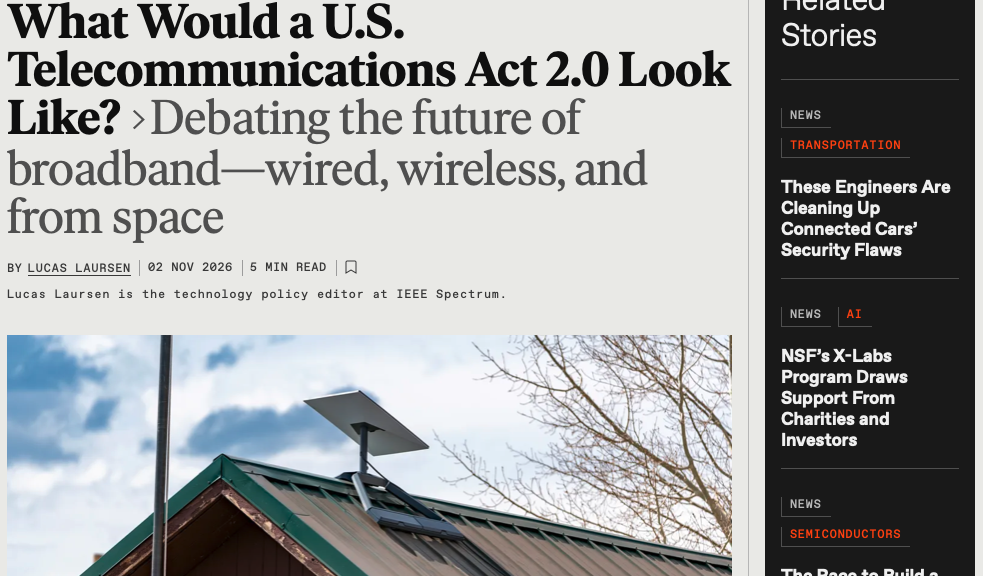
Microwave antennas like this one in Walden, Colo., connect remote towns, but a patchwork of local permitting rules can slow how fast these links go up. TONY WEBSTER
Peha, in other words, sees room for yet another category of telecom services. Wallsten, on the other hand, says Congress should avoid overspecifying what broadband means. “Whatever Congress writes will be obsolete before the ink dries,” he says. Instead, he adds, “The principle should be that minimum specifications follow what consumers actually want to buy, not what a particular technology can deliver.”
Wallsten’s observation reflects a wider tension in the industry. Some want the federal government to pay companies to lay down fiber in places where prevailing market forces wouldn’t take them. Others prefer emerging alternatives, such as fixed wireless access(FWA, which uses 5G or other wireless signals for home broadband) or low Earth orbit (LEO) satellite connections. The fight depends on how the government defines broadband. If broadband is just the fastest available internet connection, then for the foreseeable future USF can only fund fiber.
“A subsidy that only fiber can win is a government decision about who gets to compete,” Wallsten says.
It Would Reform Infrastructure Permitting
Connecting the unconnected using federal dollars is one thing. Getting permission is another, especially when digging permits for fiber-optic cable might conflict with other local infrastructure, like roads or railways. “Local authority of permitting is essential,” says Sean Gonsalves of the Washington, D.C.–based Institute for Local Self-Reliance’s Community Broadband Networks initiative. However, he adds, it may take states and the federal government to streamline digital permitting to encourage telecom companies to invest in more fiber or microwave backhaul infrastructure.
The 1996 Telecom Act did preempt states from some permitting, but many in the industry argue the Act did not go far enough and was rife with contradictions. “Cellular siting and power siting are long-standing problems in communications law,” Thierer says. “Congress needs to do a better, more thorough accounting of where there are impediments to wireless and wired rollouts,” he says.
Digging trenches to lay fiber-optic cables and installing new cell towers do create local impacts, which is why local governments have sought permitting authority. However, local rules vary widely across the country and create both time and cost barriers for telecom companies seeking to work in new territory.
Right now, the FCC is proposing to eliminate “excessive delays and fees” through a rule. But local governments are pushing back, claiming that the FCC lacks the necessary authority, that their permitting processes protect safety, and that companies sometimes fail to build even when they have permits.
For a new Telecom Act to work, it has to balance competing needs: between building new cables and towers and letting people have a say when those projects affect them.
It Would Encourage More Competition
A Telecommunications Act 2.0 would encourage competition differently by updating the ways it allocates spectrum and by discouraging market concentration. Since even before 1996, the federal government has auctioned licenses to use select bands of the radio, microwave, and millimeter-wave spectrum for communications and broadcasting. This allows companies to pay for their needs according to their priorities and raises money for the federal government.
Thierer favors a role for the federal government in orchestrating spectrum auctions but says “it doesn’t need to be done by the FCC in such a highly regulated and siloed way.” Instead, he says, the government could use the National Telecommunications and Information Administration (NTIA) to handle the technical side of allocating spectrum.
Peha proposes a broader monitoring role, beyond telecom networks or broadcasters, that might also include cloud services. “A new Telecom Act should direct the FCC to expand its set of reports on the state of competition to also address cloud storage and processing,” he says.
Gonsalves also says the federal government could restore to local governments the right to build their own physical telecom networks. “We support federal and state legislation that does away with state preemption laws that are still on the books in 16 states that either prevent or erect unnecessary barriers to building their own local networks,” Gonsalves says.
The challenge for a Telecom Act 2.0 is to make those decisions for the foreseeable future without trapping users into yesterday’s assumptions—and technologies.
It’s also worth adding one final wish to the list: The Act before the current one was from six decades earlier. When it ultimately does write its Telecom Act 2.0, Congress shouldn’t wait as long as it did between the Communications Act of 1934 and the Telecommunications Act of 1996.
First published by IEEE Spectrum: [html].